


I bought my first Talking Heads cassette with lawn-mowing money.
Whatever CBGB had been was over by the time its world reached me. The Bowery was somewhere else. The room was somewhere else. The sweat, the bad plumbing, the cheap rent, the noise, and the improbable concentration of people who would become important had already begun the long conversion from lived experience into cultural property. Eventually CBGB could fit on a T-shirt.
I. The Naive Melody
That is what happens to places after the people leave. The record gets compressed. A room becomes a logo. A scene becomes an aesthetic. The complicated thing that happened there gets reduced to the handful of names everybody remembers and the several hundred names almost nobody does.
Talking Heads survived the compression. So did Ramones, Blondie, Television, Patti Smith. A kid with a lawn mower could find the cassette years later, nowhere near the Bowery, and follow the trail backward. That is roughly what I did. The music was strange enough to make you curious about the people who had made it. Curiosity led to interviews, interviews led back to New York, art school, CBGB, the way the band worked, and eventually to the story of one particular song.
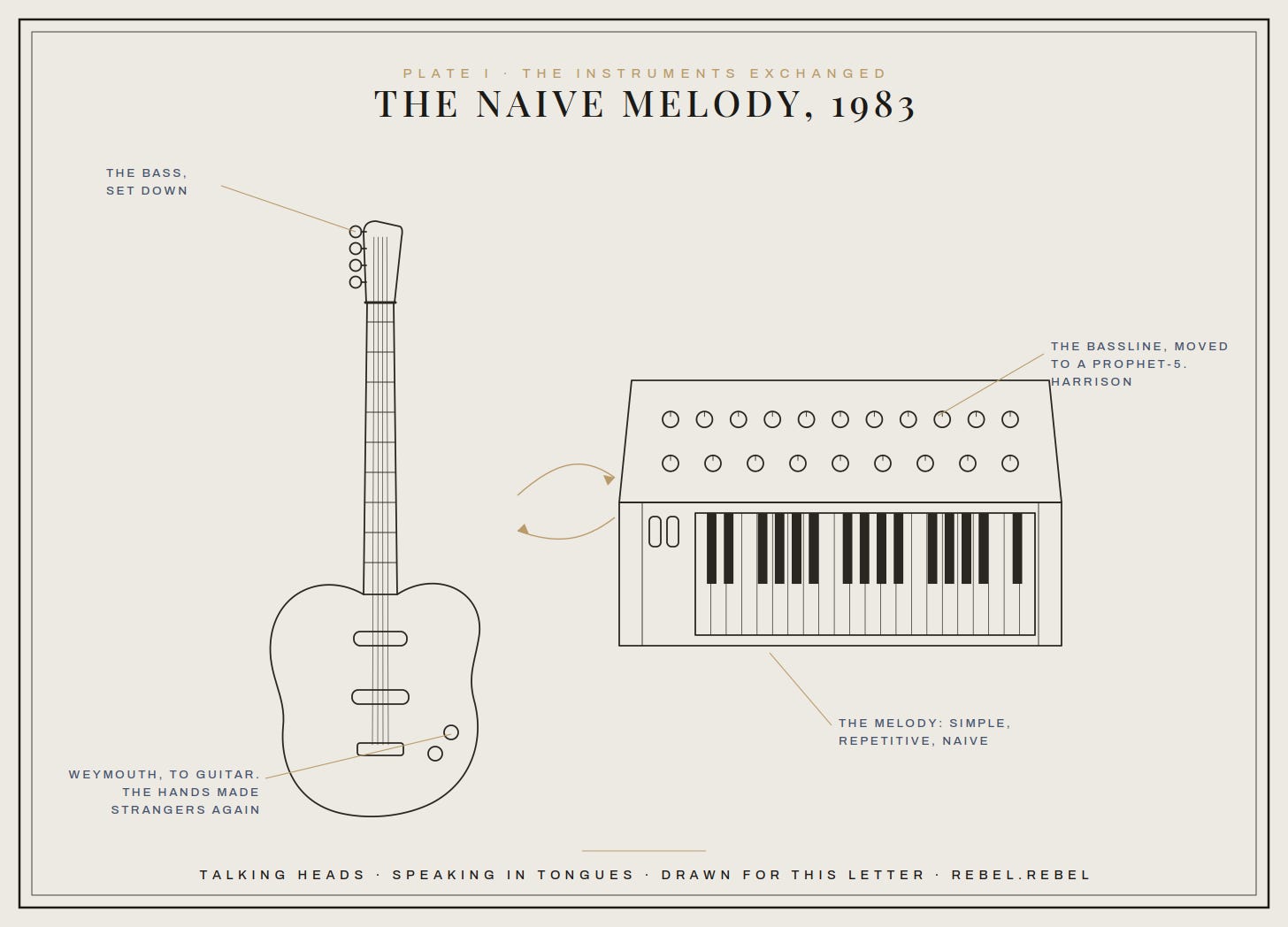
This Must Be the Place (Naive Melody). Speaking in Tongues, 1983.
To record it, the band put down their own instruments. Tina Weymouth, one of the great bass players of her generation, played guitar. Jerry Harrison took the bassline on a Prophet-5 synthesizer. David Byrne moved between guitar and synthesizer, playing what his hands did not already know. Instead of relying on the fluency they had earned, they made themselves slightly incompetent again. The melody that came out was simple, repetitive, naive. Hence the subtitle.
Nobody had forgotten how to play. They had become good enough to understand that knowing how to play was starting to determine what got played. So they changed instruments. What came out is one of the most enduring songs the band ever recorded.
I have thought about that story for years. Lately, for a reason that has very little to do with music.
II. The Instruments
I have spent my working life in the rooms where companies are told what they mean.
That work has instruments too. Position. Mission. Vision. Proposition. Audience. Reasons to believe. Architecture. Voice. Hand a competent strategist a company and the hands begin moving on their own. Find the tension. Map the category. Interview the customer. Locate the whitespace. Write the purpose. Build the architecture. Send the company into the market with language it can carry.
There is nothing inherently wrong with any of this. I have made a career of it. But fluency has consequences, and the chief one is that the strategist eventually begins hearing the instrument before hearing the company. An old manufacturer becomes timeless craftsmanship. A family business becomes authenticity. A difficult process becomes quality. A strange local habit becomes heritage. A century of accumulated decisions becomes a pyramid with three words in it.
The strategy gets clearer. The company gets harder to see.
For some time I have been arguing that machines are about to punish this habit. Not because machines understand brands. Because they read. A conversational machine asked to recommend something has no access to what the founder meant, what the creative director knows, what the old employee remembers, what everyone in the workshop understands without saying. It has the record. What was written. What was published. What was repeated. What survived.
And the modern company has spent decades translating itself through departments until much of what reaches that record is category language. The company knows something specific. Strategy compresses it. Marketing simplifies it. Communications distributes it. Channels adapt it. Search indexes what remains. Then a machine is asked which company is different.
I have mostly treated this as a one-way problem. Recover the facts. Repair the record. Write the missing sentences. Make the company retrievable again.
Then I came across a company that had been authoring the answer for five hundred years, and the argument turned over in my hands.
III. The Invoice
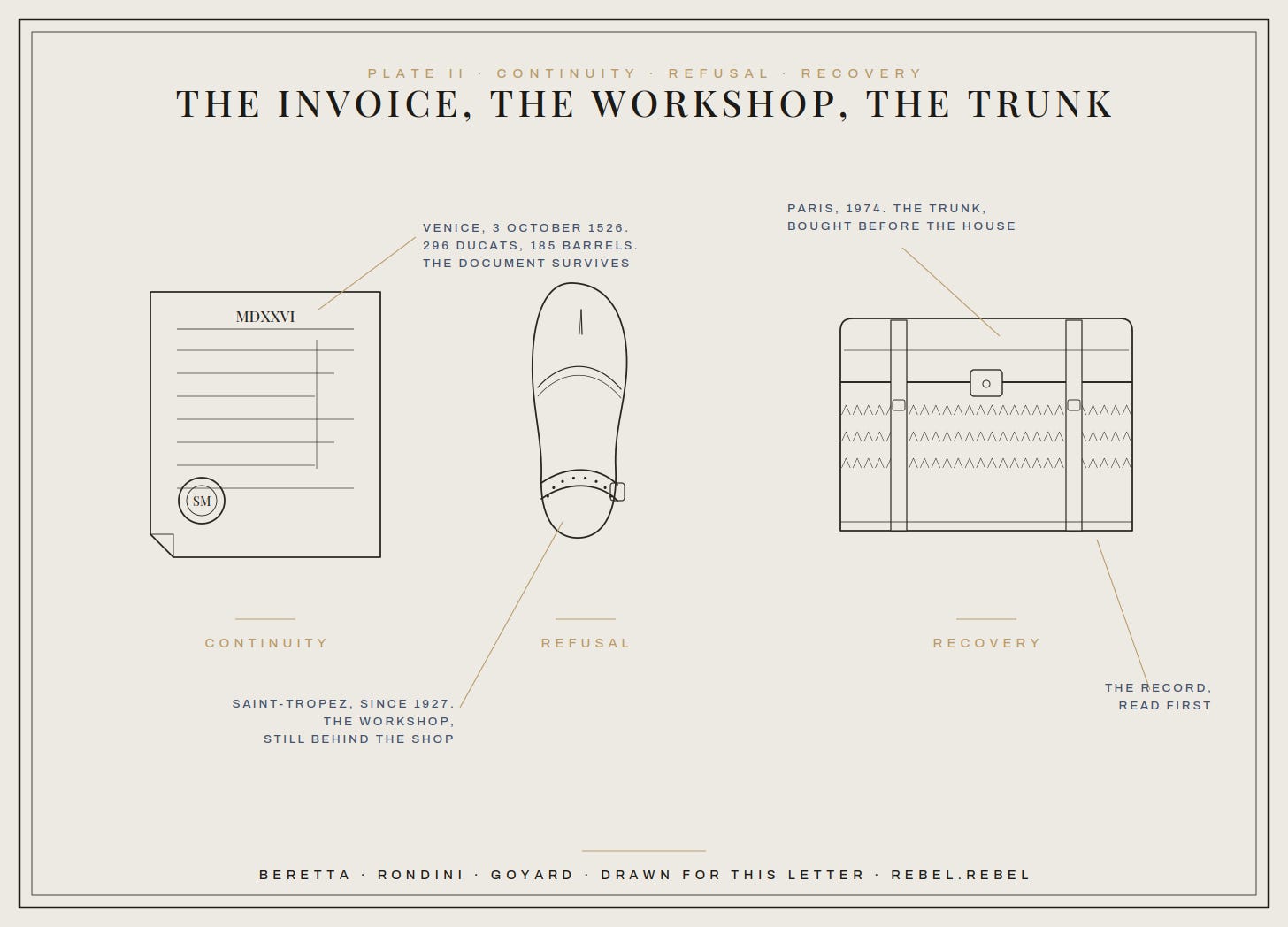
On the third of October, 1526, the Republic of Venice paid Bartolomeo Beretta 296 ducats for 185 arquebus barrels.
The document survives. It sits in the Venice State Archive, and its survival matters more than its date. Plenty of companies keep an old year under the logo, polished by generations of marketing departments until it functions as decoration. Since 18-whatever. A small typographic assurance that somebody was doing something before you were born.
Beretta has the receipt.
Five hundred years later, the Beretta family is still making firearms in the Val Trompia. Fifteen generations separate the invoice from the company operating today. The metallurgy changed. The machines changed. The wars changed. The customers changed, from Venetian armourers to hunters, Olympic shooters, police departments and armies. The obligation did not change much. Make the thing accurately. Make it reliably. Make the next one better.
This is provenance in an unusually pure form, because almost none of it needs to be invented. There is a family. There is a valley. There are factories, weapons, contracts, craftsmen, and five centuries of objects that can be placed on a table. Ask a conventional strategist to establish Beretta’s heritage and you have already made a category error. Beretta does not need heritage. It has evidence.
And here the argument I had been making began to invert. If the public record is deep enough, specific enough, continuous enough, perhaps nobody needs to teach the machine what the brand means. Perhaps the machine can read the evidence and arrive there itself.
Ask it: I want an Italian shotgun I can give my son someday. I care about craftsmanship and history, but I want something proven enough to actually hunt with. What should I buy?
That is not a search term. It is a life. The machine translates the life into criteria, weighs the available record, and produces an answer. Beretta has spent five hundred years making that answer easier. Family. Place. Craft. Service. Sport. Metallurgy. Contracts. Dates. Names. Proof accumulating on proof. The position exists whether the positioning statement does or not.
That should make a strategist nervous. For a moment, it made me wonder whether the profession was becoming less necessary.
Then I went to Saint-Tropez.
IV. The Workshop
Rondini has made sandals in Saint-Tropez since 1927.
The date is almost misleading, because the Saint-Tropez of 1927 is not the Saint-Tropez we carry in our heads. Bardot had not arrived. The yachts had not arrived. The international luxury industry had not yet turned the village into an adjective. Saint-Tropez was a place before it became a proposition, and that is where Rondini began.
Which is what makes the company so interesting now. The sandal does not evoke Saint-Tropez. It comes from Saint-Tropez. The difference is large enough to build an entire theory of brands on. The workshop is still attached to the shop. The leather is still cut, stitched, glued and assembled there. A customer can walk in off the port and have the sandal fitted to the foot.
That is not storytelling. It is geography.
Modern brand management spends enormous energy reproducing this condition after the fact. We build flagships. We commission founder stories and films about craftsmanship. We photograph workshops, hire artisans for activations, manufacture scarcity, send people somewhere beautiful and call the resulting campaign provenance. Rondini has the annoying advantage of actually being there.
It is also small, and that part matters. If Beretta is evidence that provenance can survive scale, Rondini presents the more uncomfortable possibility: sometimes provenance survives because scale never arrives.
Imagine the deck. Awareness is limited. Distribution is narrow. Production is constrained. Hand fitting creates friction. The addressable market dwarfs the current business, the brand holds considerable latent equity outside France, and there are obvious opportunities in wholesale, hospitality, collaboration and international retail. Not one of those observations has to be wrong. That is the danger. The most destructive advice in business is often perfectly rational. A workshop in Saint-Tropez is inefficient. A family cutting leather by hand is inefficient. Repairing things is inefficient. Refusing distribution is inefficient.
Until somebody asks: why Rondini? Then the inefficiencies become the answer. What finance calls inefficiency, provenance calls proof.
That is the romantic reading, and it is not sufficient. Romance does not pay wages simply because it deserves to survive. A company can possess extraordinary provenance and still be commercially under-realized. A workshop can know exactly what it is and still fail to make that knowledge useful to the next generation of customers. Truth and legibility are not the same thing.
Rondini knows what Rondini is. The woman who has bought its sandals for thirty years knows. The person kneeling with the strap knows. The family knows. Saint-Tropez knows. A woman in Chicago asking a machine for a pair of genuinely handmade Mediterranean sandals may never find out.
The machine cannot walk into the workshop. It cannot smell the leather, or watch the fitting, or inherit what everyone there understands without saying. It can read. And this is where Beretta’s apparent lesson breaks. A record can be pure and still be quiet. Provenance does not automatically become language. Language does not automatically become a record. Being the answer and being available to be answered are not the same thing.
Rondini does not need someone to invent what it means. It may need someone to make what it means legible. That is a different kind of strategist.
And there is an old French house that shows what happens when somebody gets the distinction right.
V. The Trunk
In 1974, in a Paris antique shop, Jean-Michel Signoles bought an old Goyard trunk.
He did not own Goyard. He bought the trunk anyway, and then he kept buying. That is a wonderful way to enter a company, because it begins with evidence rather than ambition.
The house he was collecting stretched back through François Goyard, who took the business over in 1853, to Maison Martin, established in Paris in 1792 as a specialist in boxes, trunks and packing. The distance between those words and the modern word luggage is worth keeping. A trunk was not merely something you carried. It existed because you were going somewhere and certain things could not be left behind. Clothes. Letters. Jewellery. Books. A life edited down to what could travel. The trunk maker worked the border between belonging and departure, and Goyard kept records of the people who crossed it. Nominal index cards, order after order, decade after decade. The Duke and Duchess of Windsor stayed on the cards for forty-seven years. The archive became a record not merely of a company but of how certain people moved through the world.
By the time Signoles bought the house in 1998, he had spent twenty-four years reading it. Only then did he become responsible for writing its next sentence.
Then something unusual happened. Goyard grew. Workshops expanded. Stores opened around the world. The house became commercially legible to another generation of customers, and none of it required inventing a founding purpose. The purpose was sitting in the trunks.
But somebody still had to make the inheritance useful. Somebody had to decide what could expand and what could not. What could be translated and what had to stay untranslated. Which codes carried meaning and which were merely old. Which constraints protected the house and which simply constrained it.
That is strategy. Good strategy, anyway.
VI. The Wrong Instrument
The workshop session begins, and everyone reaches for the instrument they already know how to play. There is a consumer tension. There is whitespace. There are three territories on a page. Eventually somebody puts a sentence in the middle of a diagram. The process is easy to mock because so much of what it produces deserves to be mocked.
But perhaps the instruments were never the problem. Perhaps we pick them up too early.
That is what I take from Talking Heads. When musicians become sufficiently accomplished, competence itself starts exerting pressure on the outcome. The hand knows where to go. The chord arrives before curiosity does. So move the players. Give the bassist a guitar. Give somebody else the bass. Make expertise uncomfortable enough that attention returns.
A strategist entering Beretta should not begin with a positioning exercise. Read the 1526 invoice. Go to Gardone. Understand why gunmaking came out of that valley and not another. Watch steel become a barrel. Hold something made a century ago and something made last Tuesday, and ask what changed and what did not.
A strategist entering Rondini should not begin with a growth opportunity. Stand behind the counter. Watch a foot get measured. Ask why the leather is cut that way, which customer has been coming longest, which repair nobody could bear to throw away, what the family has repeatedly refused to do.
A strategist entering Goyard should open the trunk. Read the ledger. Find the first customer who came back. Find the thing that survived ownership, fashion, war, aviation and the invention of the rolling suitcase.
Only then do you get your instruments back.
And here is the inversion I did not expect. They may matter more now. Not less.
VII. The Second Reader
For years, the language of brand strategy could afford to be ceremonial. A mission could live on the office wall. A vision could open the annual report. A positioning statement could stay inside the company while advertising translated it into something more interesting. Even a mediocre strategy could be rescued downstream by a brilliant creative director, a salesperson, a shopkeeper, a journalist, a customer. There were human beings all through the system, quietly correcting the sentence.
The retrieval age removes that forgiveness. A machine does not know the positioning deck was only meant as an internal alignment tool. It encounters the record the deck produced. If the strategy says timeless craftsmanship for the modern consumer, the language migrates. Into the website, the retailer description, the press release, the executive interview, the product page, the caption, the brief, the article, the listing. One generic sentence fathers another until there are thousands. Then a machine is asked which company is different.
This is why the blandness of conventional brand strategy is no longer merely an aesthetic crime. It can become a commercial one. Everything a company publishes is now evidence from which machines assemble recommendations. A bad positioning does not just fail to inspire. It contaminates the record. A good one organizes it.
That changes the standard for every instrument in the case. The position cannot merely sound differentiated. It has to be true enough to propagate. The mission cannot merely motivate employees. It has to name an obligation the company can repeatedly prove. The vision has to tell the business what it may become without destroying what made it worth becoming more of. The proposition has to compress enough evidence that the promise survives outside the room where it was written. And reasons to believe are not an appendix. They are the case.
Every public sentence now has a second reader. That does not mean companies should write for machines. The quickest way to ruin this would be to turn every website into an encyclopedia of optimized claims. The machine is useful precisely because it reads what humans wrote for other humans. But the second reader changes the consequence of omission. A fact that stays inside the workshop cannot help Rondini answer a question asked in Chicago. Knowledge that lives only inside the Beretta family cannot distinguish Beretta when somebody asks about inherited craft. A Goyard story sitting unseen in the archive cannot become part of a recommendation.
Machines cannot retrieve reverence. They retrieve records.
So the retrieval age hands provenance companies a strange new obligation: write down what everybody thought went without saying. Not everything. The right things. The workshop still matters more than the paragraph about the workshop. The object still outranks the product description. But the things modern management treated as friction, the address, the maker, the material, the year, the repair, the refusal, the method, have become the exact information that lets a machine tell one company from another. Specificity used to be expensive to communicate at scale. Now specificity is what distinguishes. Provenance has become computationally useful.
That sounds colder than the thing itself. It should. The machine does not need to understand the romance of a sandal fitted to a foot in Saint-Tropez. It needs enough specific evidence to know the romance actually happened.
VIII. Compression Without Betrayal
CBGB got compressed into a T-shirt, and something was lost. Of course it was. The smell did not survive. The rent did not survive. The particular fear of walking down that particular block at that particular hour did not survive. Thousands of nights did not survive, and most of the bands did not either. But the T-shirt did. So did some records, photographs, interviews, flyers, stories, songs. Enough that a cassette found its way into the hands of a kid with lawn-mowing money.
Compression is not the enemy. Without compression, almost nothing travels. The problem is what survives the trip.
Beretta has five hundred years. Rondini has ninety-nine and a workshop. Goyard has trunks, ledgers, addresses, techniques and customers stretching across more than two centuries of travel. Nobody gets to carry all of that around. Not the employee. Not the customer. Not the machine. Somebody has to compress it, and the question is what gets lost.
This is where most brand work fails. Compression becomes reduction. A strange, specific company enters the process and a category proposition exits. Five hundred years becomes heritage. A workshop becomes craftsmanship. Saint-Tropez becomes Mediterranean lifestyle. A customer ledger becomes personalization. Every word technically defensible. Every word destroying information.
The job is compression without betrayal. Find the smallest sentence that retains the greatest amount of proprietary truth. That is positioning. Seen this way, the old instruments become interesting again. Position states what the record uniquely permits the company to claim. Mission names the obligation it inherited. Vision says where that obligation can go next. Proposition makes the inheritance valuable to another human being. Reasons to believe tie every claim back to evidence.
Strategy makes the truth legible. Editorial puts it into the public record. Commerce tests whether anyone cares. And now machines test whether the meaning survived.
That last condition is new.
IX. This Must Be the Place
There is a line in the song about home. I will leave it in the song. The useful thing is the title.
This must be the place. Not: we have positioned this as the place. Not: our purpose is to become the place. Not: consumers perceive us as owning the territory of place. The evidence has accumulated until the conclusion feels unavoidable. This must be it.
That is what the best provenance houses possess. Beretta does not need to perform five centuries of gunsmithing. Rondini does not need to evoke Saint-Tropez. Goyard does not need a mythology of travel. The source is still there. But the existence of the source does not absolve anyone from making it understood, and that is where I had this backwards. I thought the retrieval age might shrink the strategist’s job, because machines could increasingly read the record for themselves. Beretta makes that plausible. Rondini breaks it. A record can be extraordinarily pure and commercially illegible. Somebody still has to decide what matters. Somebody still has to find the sentence.
Because heritage is not provenance. Heritage is elapsed time. Provenance is the chain of evidence connecting what a company says now to what it actually did before. Break enough links and the date under the logo becomes decoration. Preserve them and the company becomes difficult to counterfeit. Make them legible and something better happens: the company becomes easy to find for the reasons it deserves to be found. That is the commercial opportunity. Not to turn provenance into content. To turn evidence into preference.
So the job is not to manufacture meaning, and it is not to sand the strange edges off until the company becomes scalable. It is to read first. To distinguish evidence from ornament. To know which inefficiencies are proof, which traditions carry meaning and which merely carry age, what can change and what cannot. And then to perform the hardest act in the whole process: make it simple without making it generic.
I think about that cassette. By the time I bought it, I could not go to the CBGB that made Talking Heads possible. That place was already becoming a T-shirt. But enough survived. A name, a record, a song, an interview, a story about musicians trading instruments. Enough for a kid nowhere near the Bowery to follow the trail backward until the compressed thing opened up again.
That may be the standard. Not to preserve everything. You can’t. Not to make the T-shirt carry the whole room. It can’t.
What falls to the strategist is what fell to the band. Change instruments. Read the invoice. Stand in the workshop. Open the trunk. Listen until the melody becomes obvious. Then write the sentence.
And leave enough truth in the record that a stranger can find the way back.
THE RECORD
BERETTA. On 3 October 1526, master barrel-maker Bartolomeo Beretta of Gardone Val Trompia was owed 296 ducats by the Republic of Venice for 185 arquebus barrels. The account document is held in the Venice State Archive. Fifteen generations of the Beretta family separate that document from the company operating today in the Val Trompia, Province of Brescia.
RONDINI. Sandal production in Saint-Tropez since 1927. The workshop remains attached to the boutique; leather soles are oak-bark tanned for twelve months; cutting, stitching, gluing and assembly are done on site, and fitting, strap adjustment and repairs are done in the shop. Four generations of the family have run it. Rondini describes itself as Saint-Tropez’s first sandal maker. The count in Section VIII is exact: 1927 to 2026 is ninety-nine years, not a century.
GOYARD. Maison Martin established in Paris in 1792 by Pierre-François Martin, specialist in box-making, trunk-making and packing. François Goyard took over the house following the death of Louis-Henri Morel in 1852 and gave it his name in 1853. Customer orders were tracked on nominal index cards; the Duke and Duchess of Windsor appear as clients from 1939 to 1986, forty-seven years. Jean-Michel Signoles bought his first Goyard trunk in a Paris antique shop in 1974, per the house’s own published history, and acquired the Maison in 1998. Workshops were subsequently built in Carcassonne and stores opened internationally.
TALKING HEADS. “This Must Be the Place (Naive Melody),” Speaking in Tongues, Sire Records, 1983. Per Tina Weymouth’s published account of the session: Weymouth on guitar, Jerry Harrison playing the bassline on a Prophet-5 synthesizer, David Byrne moving between guitar and Prophet-5. The subtitle refers to the song’s deliberately simple, repeating construction; Byrne described the song as built through naive experimentation with unfamiliar instruments.
CBGB. Founded by Hilly Kristal at 315 Bowery, New York, December 1973; closed October 2006. The claim in the opening is autobiographical: the scene, not the club, was over by the time it reached the author.
VERIFIED 10 August 2026. Corrections, if the record demands them, will be entered into this text and dated.
Austin Ripmaster is the founder of Rebel.Rebel, an independent research and editorial practice for the retrieval age.
