


Letters from Digital Pompeii, two of six.
Part one: Digital Pompeii →
Most brands were not buried by AI.
They buried themselves.
That sounds like an accusation.
It is mostly a history.
The strange thing about the real Pompeii is not that a city disappeared.
Cities disappear all the time.
The strange thing is what survived.
Graffiti.
Election notices.
Bread in ovens.
Shop signs.
Names scratched into walls.
Ordinary evidence of particular people doing particular things in a particular place.
The eruption destroyed the city and accidentally preserved its fingerprints.
Our version did almost the opposite.
We produced more commercial language than any generation in history.
And somehow removed the fingerprints.
A million pages about craft with no craftsperson.
A million pages about quality with no mechanism.
A million pages about community with almost no peculiar human being behaving peculiarly.
A million pages about innovation with no dated decision anyone was willing to own.
That is the ash layer.
The posture survived.
The person disappeared.
How did we manage that?
Rationally.
One reasonable decision at a time.
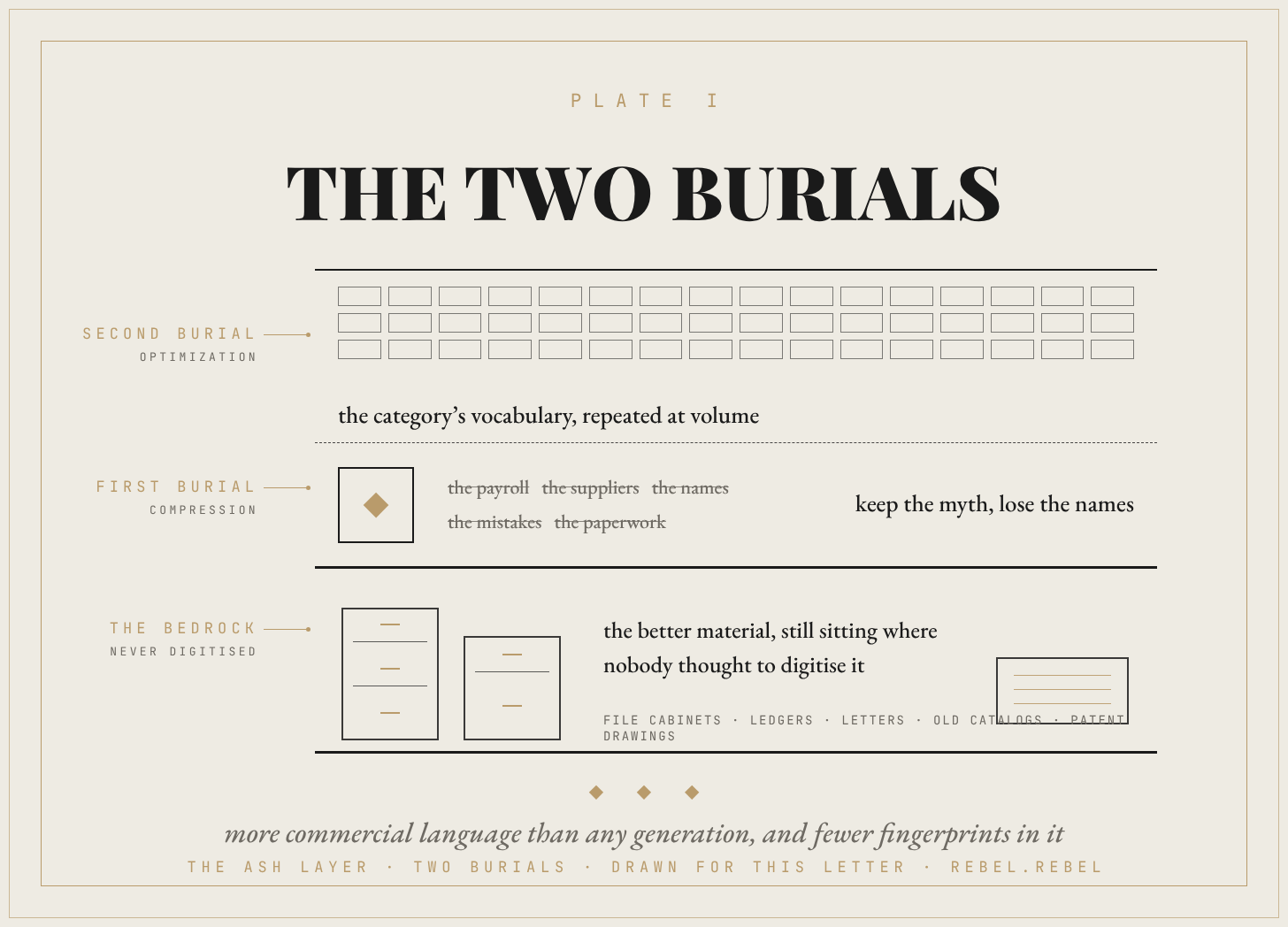
I. THE FIRST BURIAL
For most of the twentieth century, brands compressed because they had to.
The channels were narrow.
A company had thirty seconds between sitcom scenes.
A founder had to fit on a package.
A hundred years of payroll, patents, arguments, suppliers, machinery, mistakes, customers, and dead employees had to become one image light enough to travel.
So the cowboy won.
The swoosh won.
The contour bottle won.
The man on the horse won.
This was not stupidity.
It was excellent engineering.
You cannot broadcast a payroll.
You can broadcast a man.
You cannot explain a supply chain in thirty seconds.
You can say quality.
You cannot introduce twenty-seven people who touched the product.
You can show one pair of hands.
Compression was the price of reach.
Keep the silhouette.
Lose the paperwork.
Keep the myth.
Lose the names.
Keep the meaning.
Lose the mechanism.
The first burial was imposed by bandwidth.
Then the internet arrived.
For the first time in commercial history, room was nearly free.
The factory could have had a page.
The failed prototype could have had a page.
The woman who changed the stitch could have had a page.
The supplier could have been named.
The founder’s bad idea could sit beside the good one.
The archive could have come upstairs.
We had the room.
And this is where the story gets interesting.
Because we did fill it.
Just not with what had been missing.
You cannot broadcast a payroll. You can broadcast a man.
II. OWNED, BUT NOT AUTHORED
The 2010s gave brand teams a powerful new idea.
Owned media.
Your domain.
Your blog.
Your email list.
Your app.
Your channel.
No publisher standing between you and the audience.
Nobody could take the pipe away.
The industry heard owned and thought about distribution.
It asked far less often whether the language itself was owned.
That distinction now looks enormous.
We owned the pipe.
Much of the time, we rented the sentences.
The system that produced them was rational.
I know because I worked inside it.
The keyword tool showed what people were searching.
The search term became the brief.
The page answered the search term.
The crawler rewarded relevance.
The dashboard reported traffic.
Traffic justified more pages.
More pages produced more data.
The data produced the next brief.
No villain required.
Everybody did his job.
The problem was hidden inside the source of the brief.
A keyword tool can only tell you what people already know how to ask for.
That makes it extremely useful for capturing existing demand.
It also means the language of existing demand begins flowing upstream into the language of the company.
Best running shoes.
Best mattress.
Premium basics.
Sustainable skincare.
Luxury western boots.
Healthy snacks.
Affordable alternatives.
The category supplied the vocabulary.
The company paid for production.
The search engine graded the answer.
Then the company published the category’s language on its own domain.
Ten posts a month.
Forty a quarter.
Hundreds a year.
Multiply that by nearly every serious company in nearly every serious category.
The broadcast century cut specifics because there was no room.
The digital era often cut them because there was no demonstrated search volume.
That is a very different mistake.
The first burial was constraint.
The second burial was optimization.
III. THE CUSTOMERS KEPT THE RECEIPTS
There is an important correction to this history.
The internet did not erase detail.
It produced an astonishing amount of it.
Just often not where the brand team was looking.
While companies wrote premium craftsmanship, an owner on a forum photographed the broken hinge.
He named the model year.
He posted the replacement part.
Someone else explained that the 2009 version used a different supplier.
A third person uploaded a repair video.
A fourth compared three generations and explained which one to buy used.
The official site wrote the abstraction.
The customer wrote the record.
This happened everywhere.
Reddit.
Forums.
YouTube.
Owner clubs.
Review sites.
Fan pages.
Repair communities.
Enthusiast blogs.
The corporate internet often became smoother as the unofficial internet became more specific.
That is one of the great ironies of the period.
The people with the largest budgets produced the cleanest language.
The people with almost no budget produced the receipts.
The company said built to last.
The owner said mine made it 184,000 miles and here is the part that failed first.
The company said heritage craftsmanship.
The collector identified the factory, the last year of the old construction, the person who ran the machine, and the mistake that makes one run more valuable than another.
The company said community.
The community argued for seventeen pages about whether the new version had ruined the thing.
Which record would you rather interrogate?
That question barely mattered when discovery meant reaching a webpage.
It matters much more when discovery begins with a system that can read across records.
Because now the unofficial particulars and the official abstractions enter the same consideration set.
The customer kept the receipts.
The machine can increasingly find them.
IV. THE MILLION-PAGE CITY
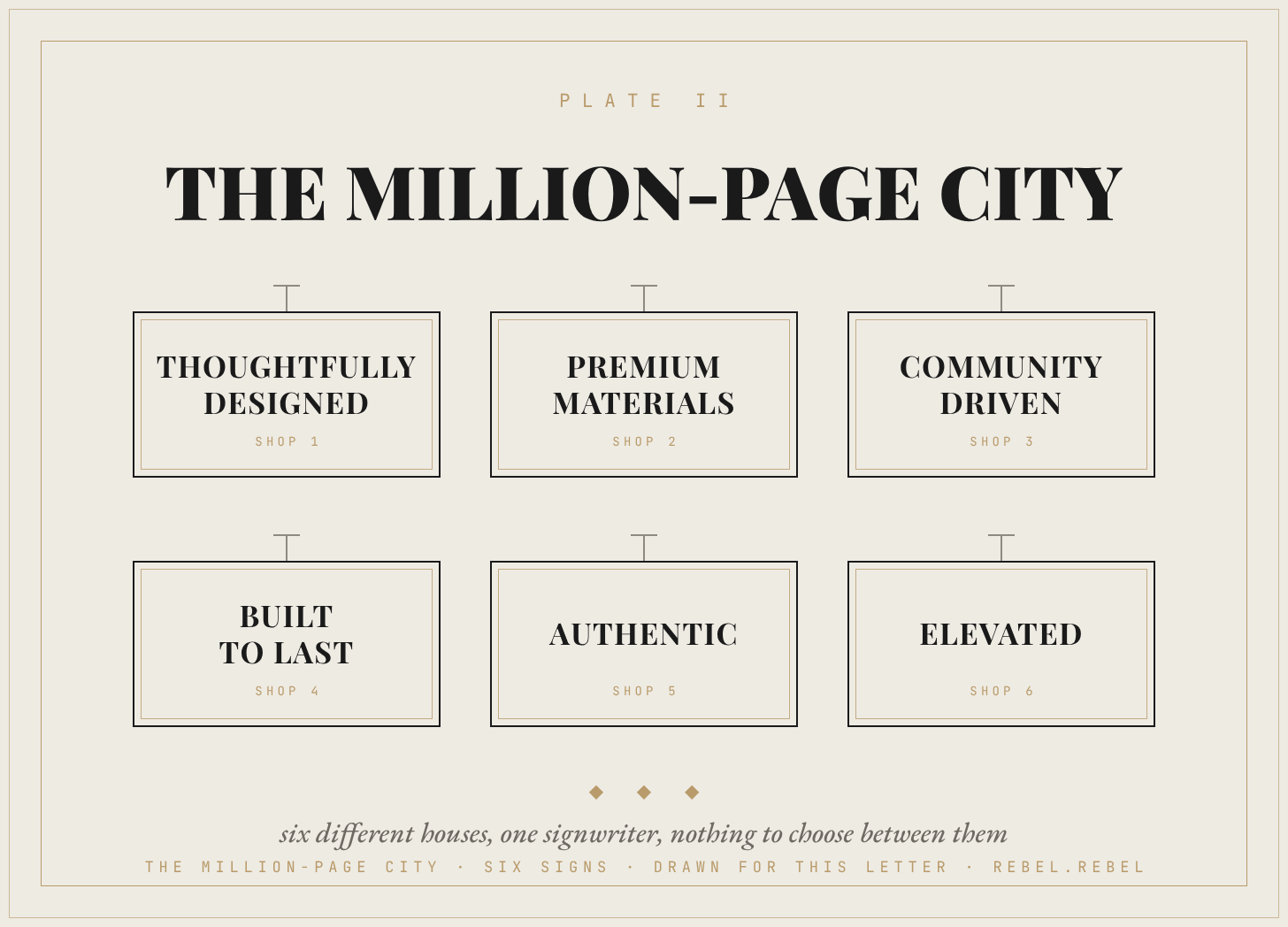
Open one brand site and thoughtfully designed sounds reasonable.
Open another and premium materials sounds reasonable.
A third is community driven.
A fourth is built to last.
A fifth is authentic.
A sixth is elevated.
Each claim can survive alone.
The problem appears when the records are compared.
Search rewarded companies for covering shared demand.
That made sense.
Generative systems operate differently. Depending on the system and the task, they can retrieve multiple sources, compare alternatives, re-query, summarize disagreement, and compress many records into one response.
Under those conditions, repetition behaves differently.
A repeated claim can strengthen a general association.
But it can also weaken ownership.
If every premium brand says exceptional quality, exceptional quality may still matter.
It just does less to distinguish who owns it.
At corpus scale, repetition begins to look less like authorship and more like consensus.
That is the shift.
The first internet rewarded coverage of shared demand.
The second is much better equipped to notice which parts of that coverage are shared by everyone.
And a shared claim has a peculiar property.
Everybody can benefit from it.
Nobody gets to keep it.
The language companies used to become findable can therefore become the language that makes them harder to distinguish.
Not because AI is punishing optimization.
Because comparison exposes similarity.
That is a much more uncomfortable diagnosis.
The machine did not create generic brand language.
It merely became a reader capable of encountering more of it at once.
Everybody can benefit from it. Nobody gets to keep it.
V. THE ANTI-POMPEII
Return to the real Pompeii.
The city is valuable because the mundane survived.
Names.
Transactions.
Instructions.
Arguments.
Evidence.
Our digital city preserved enormous amounts of corporate language and surprisingly little corporate life.
The word craft survived.
The craftsperson often did not.
The word innovation survived.
The disputed decision did not.
The word heritage survived.
The original ledger remained in a drawer.
The word community survived.
The names of the people who actually kept the community alive were never entered into the record.
This is why Digital Pompeii is an inversion.
The Roman ash preserved particulars.
Our ash is made of abstractions.
And underneath it, the better material is often still sitting where nobody thought to digitize it.
File cabinets.
Ledgers.
Letters.
Old catalogs.
Patent drawings.
Supplier invoices.
Employee memory.
Customer rituals.
The retired machinist who remembers why the specification changed in 1987.
The salesperson who knows the founder refused to enter one channel for twenty years.
The repair technician who can tell the good production run from the bad one by touch.
The product feature so familiar internally that nobody thought it deserved a sentence.
No keyword tool asked for these things.
That is precisely why they matter.
The internet did not create a shortage of information.
It created, in many places, a shortage of attributable information.
Plenty of language.
Not enough fingerprints.
VI. THE NEW VALUE OF THE PARTICULAR
For most of modern marketing, the strange detail was expensive.
It did not travel well.
A twenty-second television spot had no room for it.
A search-volume report might show no demand for it.
A social caption could not carry much of it.
So the detail was cut.
Now its economics are changing.
A named fact can survive comparison differently from an adjective.
A date can be checked.
A place can be located.
A mechanism can be explained.
A refusal can be attributed.
A failure can be traced to a decision.
A ritual can be recognized across independent accounts.
These things do not become valuable because they are old or charming.
They become valuable because they are difficult to average away.
That is the important distinction.
Specificity is not automatically truth.
A company can manufacture specifics too.
A date can be irrelevant.
A founder story can be embellished.
A provenance claim can be false.
The record still has to survive scrutiny.
But a true particular has an advantage generic language does not.
It can remain attached to its source.
The old web rewarded the phrase with demand.
The new consideration layer can reward the fact with ownership.
That changes the value of the archive.
The overlooked sentence.
The forgotten catalog.
The product note.
The customer story that names the actual place.
The employee who remembers why.
None of these is content in the old sense.
They are evidence.
VII. THE DASHBOARD STILL LOOKS FINE
This is the part that makes the transition difficult to see from inside a company.
The dashboard can still look healthy.
Traffic.
Rankings.
Followers.
Impressions.
Clicks.
Sessions.
Share of voice.
All real numbers.
All useful within their proper jurisdiction.
And none of them necessarily tells you whether the meaning attached to your name is becoming more distinctive or less.
That creates a strange modern possibility.
A company can increase the amount of language it publishes while decreasing the amount of language only it could have published.
More pages.
Less property.
More impressions.
Less attribution.
More content.
Fewer fingerprints.
The instruments were built to measure circulation.
They were not built to measure what survived the circulation.
That may be the final legacy of the ash layer.
Not merely that marketing learned to write toward what could be counted.
That it gradually stopped seeing the things its instruments could not count as commercial assets at all.
The factory story had no search volume.
The odd customer ritual had no media metric.
The founder’s refusal had no attribution window.
The named detail looked anecdotal beside the decimal.
So the decimal won.
Again and again.
Until companies possessed extraordinarily precise measurements of circulation and increasingly weak accounts of why anyone should care what was circulating.
Which raises the next question.
What happens when the instrument becomes more precise while the thing worth measuring becomes harder to see?
The modern marketing system got extraordinarily good at detecting four tenths of one percent.
It remained strangely bad at explaining why somebody lined up around the block.
That is the next letter.
Austin Ripmaster is the founder of Rebel.Rebel, an independent research and editorial practice for the retrieval age.
Download the plate edition (PDF). Free, no gate.
P-012 · THE ASH LAYER
Written on or before 15 August 2026 · Published 3 November 2026
Verified 21 October 2026