


On 22 August 2026 my family of five climbed into a bright-red dune scooter on the eastern shore of Lake Michigan.
SAND WITCH was painted across the back.
Another was called Mr. Sandman. Another, Beverly Hills. There are Dune Rovers and Sand Drifters and the sort of names that sound as though somebody came up with them over lunch, everybody laughed, and then someone went outside and painted the thing on the truck.
These are not good names according to any contemporary naming framework.
They are much better than good names.
They are theirs.
There were hand-painted signs everywhere. Red, white and black. A wooden photo board where my three kids stuck their heads through the windows of a painted dune scooter. Old family photographs. Old price boards. A binder with customers’ names written in pen. Machines retired from service and kept under a roof because apparently nobody ever decided their usefulness had ended when they stopped moving.
One of them is a 1960 Studebaker Dune Scooter.
Scooter No. 9.
The sign in front of it records the facts without improving them:
IN SERVICE 1960 to 1970.
289 V-8 engine. Traction bars. Half-ton, two-wheel-drive chassis. Sand tires. Three-speed transmission. First truck chassis.
Then:
OUR LAST 2-WHEEL DRIVE DUNE SCOOTER.
I love that sign.
Somebody hand-lettered it. Somebody decided the engine displacement was worth telling a stranger. Somebody thought the last two-wheel-drive scooter deserved to be called that, in italics, on a board, for an audience of people who mostly walk past on their way to the ticket window.
Our driver was Blake.
Blake was really funny. My kids spent most of the ride waiting for whatever he was going to say next. He also seemed to know damn near everything about the place.
Silver Lake. Lake Michigan. The dunes. The vegetation. What holds the sand. What moves. The history of the company. The Wood family. The vehicles. The conservation of the land. The surrounding community. What had changed. What had stayed. Why.
We got into the dune scooter knowing we were about to ride around on a very large pile of sand.
Forty minutes later we knew where we were.
There is a difference.
Increasingly, I think that difference is the whole business.
NO SHAME, ALL PRIDE
I have spent a career inside companies large enough to have a brand system, and what struck me at Mac Wood’s was not the charm.
It was that everything I was looking at is a behavior.
Not an aesthetic. Not an accident of a small operation that has not modernized. A set of things people do, on purpose, that a company of any size could choose to do, and that companies systematically stop doing as they grow.
Blake recites house facts. He knows the engine in a truck that stopped running before he was born. That is not personality. Somebody taught him, or the culture expects it, or both. A scaling company calls this onboarding, moves it into a deck, and measures completion.
The sign by the door says Welcome to Mac Wood’s Dune Rides, Enjoy your Ride, with three exclamation points. Nobody has ever redesigned that sign. A brand system would have redesigned it in the first quarter.
Blake’s shirt carries his first name on a red badge and nothing else. No title. No role. No last name. The company decided, at some point, that the person is the unit.
The retired machines have hand-lettered placards, made recently enough to still be legible, for people who mostly walk past.
The comment binder is in pen. Not a QR code. Not a five-star prompt. A binder, on a counter, where the last family before us wrote that it was their first time.
Forty minutes. Still forty minutes.
None of that is naive. All of it is a choice somebody keeps making.
And every one of those behaviors is something a growing company removes, for reasons that sound in the room like maturity. Consistency. Governance. Professional presentation. Scalable training. Global applicability.
Nobody in that room ever proposes removing pride.
They propose sanding it down.
That is the actual phrase. Sand off the rough edges. Smooth it out. Nobody at the table hears it, because it is one of those words that has been worn flat by use.
It is called sandpaper for a reason.
The verb people reach for when they want to make a company presentable is the same material this company sells rides on. And out here it is not an abrasive. It is the entire asset, two thousand acres of it, moving.
What gets sanded is always the same thing. The exclamation points. The goofy name. The regional expression. The hand-lettering. The founder who sounds like somebody’s uncle. And at that scale camp and pride turn out to be the same substance, so you cannot take out the one and keep the other.
No shame, all pride.
That is the operating position, and it is completely unavailable to a company that has become embarrassed about where it came from.
THE ORIGINAL STORY WAS ENOUGH
Mac Wood’s Dune Rides began in 1930.
Malcolm Wood was operating the Flora-Dale Resort at Silver Lake and wanted something for his guests to do.
So he took them onto the dunes.
The first rides were made in a modified Model A Ford. Other people wanted to come too. Eventually Mac started charging them.
Twenty-five cents.
That is the founding proposition.
A man had guests.
He had an extraordinary place outside his door.
He wanted to show it to them.
So he found a way.
There is a peculiar moment in the life of a successful company when a story like this begins to feel insufficient.
It was enough to start the business.
Enough to bring people back.
Enough to employ a family.
Enough to survive one generation and then another and another.
But somewhere along the way, it stops feeling like enough to explain what the company has become.
Too literal.
Too small.
Too provincial.
Too anecdotal.
Not strategic enough.
So somebody translates it.
Mac wanting to entertain his guests becomes a commitment to unforgettable experiences.
The modified Model A becomes a legacy of innovation.
The family becomes a people-first culture.
Knowledge of one particular landscape becomes environmental stewardship.
Blake becomes exceptional customer service.
Nothing there is necessarily false.
That is what makes the problem hard.
Every sentence may be perfectly defensible.
Every sentence is also worse.
Because every translation takes something that could only belong to Mac Wood’s and converts it into something that could belong to almost anyone.
We mistake the abstraction for a higher form of intelligence.
It isn’t.
It is a compression.
THE PROPER LANGUAGE
Large companies are under enormous pressure to become proper.
Not merely professional.
Proper.
The story needs to fit the deck.
The phrase needs to survive the boardroom.
The proposition needs to work in every market.
The history needs to be organized into pillars.
The weird thing the founder actually said gets cleaned up.
The regional expression gets translated.
The ugly photograph disappears.
The old name sounds unsophisticated.
The employee who remembers what happened is interesting, but the consultant has synthesized the themes.
This happens for reasonable reasons.
A complicated organization has to compress itself.
A CEO cannot know every story. A board cannot read the archive. An agency needs a brief. A global organization needs shared language.
The strategy deck has a job. Its job is to take a thousand particulars and make them legible to someone who has thirty minutes.
Useful.
I nearly named a specific consulting firm in that paragraph, because it is the shorthand everybody reaches for. That would have been the same move the rest of this piece is about. One company standing in for a category, used because it is faster than accuracy.
The trouble starts when the company begins believing the compression is more authoritative than what was compressed.
Three generations become three pillars.
A thousand customer encounters become a value proposition.
Thirty years of craft become a capability.
A complicated history becomes a timeline with six dots.
And slowly the management language becomes the official language while the language of the actual business becomes anecdotal.
That hierarchy has always bothered me.
Until recently the case against it was mostly a matter of taste. I thought the specific was better. I could not prove it was worth money.
That changed, and it changed because of how people now find things.
THE MACHINE IN THE MIDDLE
I almost called the vehicles dune buggies in this piece.
That was the word in my head after we left. Everybody knows what a dune buggy is. I even searched for the trucks that way afterward.
Then I looked back at my photographs. DUNE ROVER. SAND DRIFTER. And on the old Studebaker, 1960 STUDEBAKER DUNE SCOOTER.
Dune scooter. That is what Mac Wood’s calls them. That is what the old signs call them. That is what they have apparently been called there for generations.
Dune buggy is the category. Dune scooter is the record.
Later the same day I did it again, writing up what Blake had recommended to us near the end of the ride. I wrote down Sable Lighthouse. He had said Little Sable Point, correctly, and I had shortened it within hours, in notes for an essay against shortening.
So I went and asked an AI assistant for the names of the Mac Wood’s trucks.
It returned twelve. Big Red. Big Mac. Sahara Cruiser. Sand Flea. Dune Rover. Desert Fox. Ridge Runner. Dunemobile. Sand Beetle. Sand Drifter. Desert King. Water Bug.
Sand Witch is not on that list.
Neither is Mr. Sandman. Neither is Beverly Hills.
I had ridden in Sand Witch that morning. It is painted across the tailgate in letters a foot high. My children are photographed standing in front of it.
Then the answer offered to tell me more about how these custom Ford trucks are built for the sand.
Ford is not wrong. Ford is in the record in several places, starting with the Model A in 1930. What the answer did was let one true thing stand for the whole. The lineage at Mac Wood’s runs through a Studebaker and an International as well, and the fleet names it gave me are not the ones painted on the trucks I stood next to.
That is not a machine failing to understand Mac Wood’s. It understood the category perfectly. It found the right company from a question that never named it.
What it could not do was hold on to the particulars, because there were not enough of them published for it to hold on to. And where the record thinned, it did not stop and say so. It filled, in the same voice it used for the parts it actually had.
RECOVERABLE AND UNRECOVERABLE
Compression is not the enemy. Everybody compresses. I did it twice before lunch.
The question is whether the compression keeps a handle on the thing it compressed.
I said dune buggy. The dune scooter is recoverable from that, because dune buggy is at least the right category pointing at the right object. Somebody can correct me in one sentence.
I said Sable Lighthouse. Little Sable Point is recoverable from that. The name is shortened, not replaced. It still points.
A fleet described as custom Ford trucks does not point at Sand Witch. You cannot get back to a name that was never carried forward, and nothing in the answer tells you which parts were retrieved and which were assembled.
Sanding only runs one direction. You can sand a name off a truck. You cannot sand one back on.
Two operations are running here and they do not have the same reliability.
The first is translation, the customer’s question into the category’s language. The machine pays that cost now, and it pays it well. That is a real subsidy, and it is why a question can arrive unguarded, in the shape a family actually thinks in, with a bored four-year-old in it.
The second is retrieval, the category’s language back into one named company’s particulars. That one is only ever as good as the record.
The subsidy on the first is exactly what raises the stakes on the second. Somebody used to have to be specific, and for twenty years it was the customer, learning to type the words a system wanted rather than the words they had. They have been relieved of that. The specificity did not stop being necessary.
It moved. It is the company’s job now.
Which is what changed my mind about the exclamation points.
Every behavior in that first section used to be a matter of character. Keep the ugly sign or don’t. Teach the driver the engine or don’t. They read as charm, and charm does not survive a budget review.
They are now the input layer. They are what a company puts into the world for a system to find, and the alternative is a well-governed brand architecture that produces nothing specific enough to retrieve.
The camp is the asset. That is a strange sentence and I believe it.
HERITAGE IS THE SUMMARY
The word heritage appears everywhere now.
So does craft. So does community. So does authentic.
They are not useless words. They are summaries.
The problem is that brands started publishing the summary instead of the thing being summarized.
Mac Wood’s does not need to tell me it has heritage.
There is a Studebaker sitting there.
It has a number. It has dates. It has a specific engine.
There is an old sign advertising:
SCENIC DUNE RIDE PRICES
Adult $2.50.
Child under ten, $1.50.
40 MIN. TRIP.
Don’t forget your camera.
A small starburst sticker on the corner reads: Rates from 1965.
That is heritage.
Not the word.
The receipt.
Heritage is the summary. Scooter No. 9 is the evidence.
Service is the summary. Blake is the evidence.
Innovation is the summary. Mac modifying a Model A because his guests needed something to do is the evidence.
The specific precedes the strategic.
We have spent decades pretending the order runs the other way.
TERMITE BRIDGE
Near the end of the ride the trail crosses a wooden bridge over a channel. It is called Termite Bridge.
That is not a name the company advertises. I have since found it written down twice, both times by visitors describing the ride, once with the reassurance that the bridge is perfectly stable.
Crossing it, Blake announced that this was the complaints department, and that anyone with a problem could go either left or right.
We were in a dune scooter with no doors and no roof, above a channel.
Twenty-odd people came apart.
Then, without changing gear at all, he told us to go see Little Sable Point. A mile down the street. The largest lighthouse in the area, he said. He gave the height in feet.
And he said it has 127 stairs.
Then: “Use my name, there or at the pub. It will get you nothing, but I like people talking about me.”
And he drove off down the road to finish the ride with the whole vehicle still laughing.
I did not write down the number of feet he gave. Because I did not write it down, it is not in this piece. The stairs I am certain about.
ONE HUNDRED AND TWENTY-SEVEN
So I went to check him.
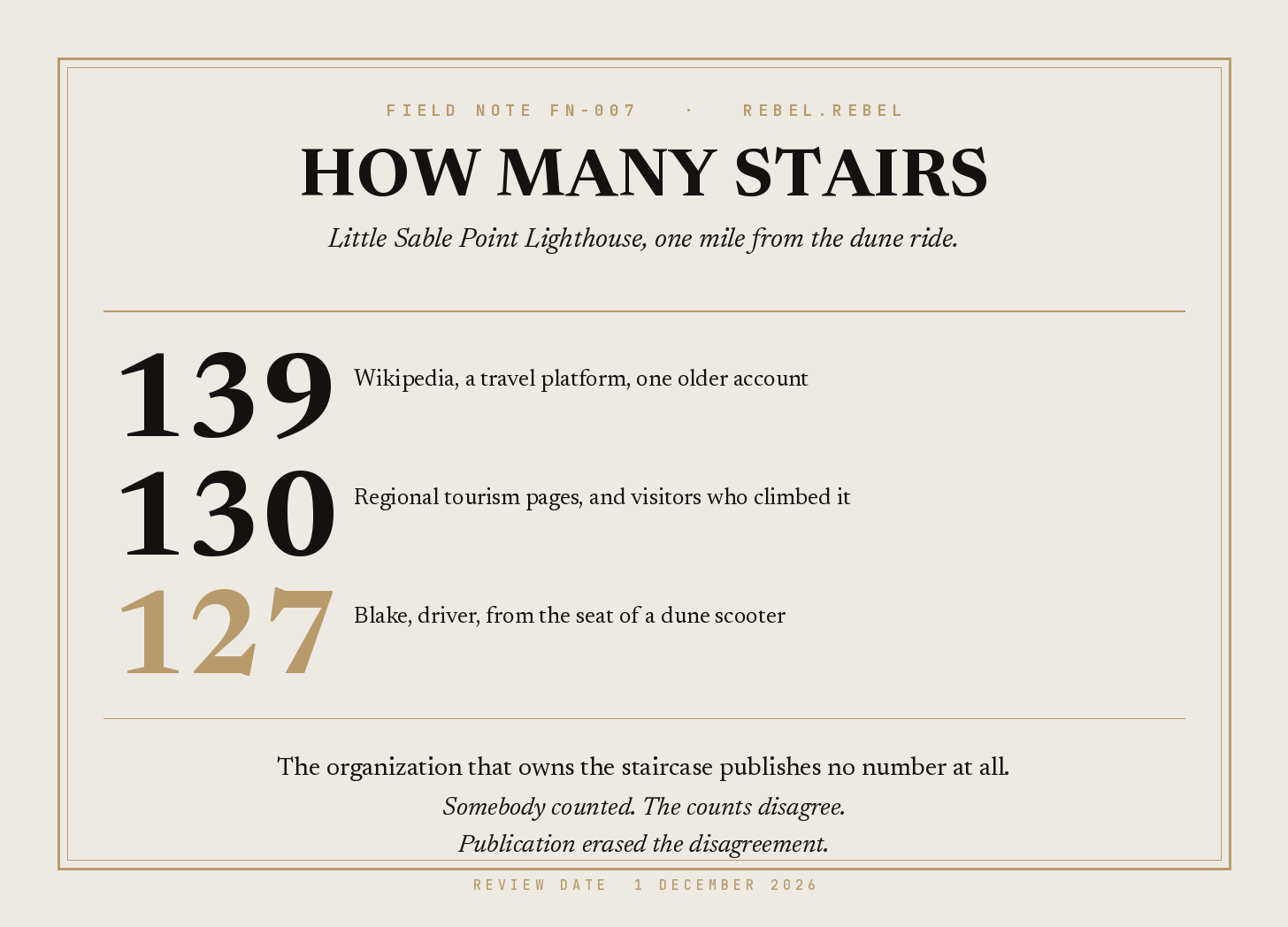
The internet gives two numbers.
Several regional tourism pages say the climb is 130 steps, and a number of visitors say the same, some of them describing the climb in the first person. Wikipedia says 139, and at least one travel platform repeats 139 in language that reads as downstream of Wikipedia. At least one older first-person account gives 139 as well.
Lakeshore Keepers, the volunteer organization that maintains the lighthouse, staffs the tower and sells the climbing tickets, publishes no step count at all on the pages I could find.
So people have counted. That is not the problem.
The problem is that the counts disagree, and every subsequent publication erased the disagreement. Each page states its number flatly, as though it were the only one. Nobody writes that the other figure exists. And the organization that owns the actual staircase says nothing.
I am going to say plainly which figure I am taking.
I am taking 127.
Not because four correct facts make a man a reliable estimator. They don’t, and I am not going to dress a preference up as a statistic.
Because the published record is already arguing with itself, and because the named human standing a mile from the staircase has so far been more precise with me than I have been with him. He gave the lighthouse its full correct name while I was busy shortening it.
There may be three broken stairs. There may be a landing that reads as a step in a drawing and not underfoot. There may be a number that was rounded once and copied since. I do not know, and I am not going to invent a reason, because inventing a reason to protect a paragraph is the failure this piece exists to name.
What I will do is stake it.
If someone climbs Little Sable Point and counts, and the count is not 127, that correction will be entered into this text, dated, in this paragraph, and this sentence will stay above it. I will report back by 1 December 2026.
One reader with a phone and a free afternoon can settle it. That is the point. Blake is checkable. A page that gives one number and no argument is not.
THE CASE AGAINST BLAKE
The strongest argument against him is a good one, and it should run at full strength.
He says this several times a day, all summer, for years. Numbers inside patter drift. The complaints department joke has clearly been told on that bridge a thousand times, and a stair count that lives next to a joke is a stair count under no pressure at all. Nobody in a moving dune scooter is going to check. A figure rounded once, early, would never be corrected, and the man delivering it would have no way of knowing.
That is entirely plausible and I cannot rule it out.
But the same argument indicts the published pages more severely, not less. They also face no pressure. They also have no correction mechanism. And unlike Blake, they cannot be asked.
He is standing a mile from the lighthouse in a company shirt with his first name on it. He has a name, an employer and a location.
That is a chain of custody. A page that says 130 has none of those things and reads as though it does.
BLAKE KNOWS MORE THAN THE DECK
A guide could have driven us over the dunes.
That would have completed the transaction.
Instead Blake spent forty minutes attaching information to everything we saw.
The dune became this dune.
The vegetation became these plants and this ecology.
The landscape became something alive enough to move.
The attraction became a family business.
The old vehicles became a lineage.
The place accumulated meaning as he spoke.
That is service too.
We tend to think of service as subtraction. Remove friction. Shorten the line. Simplify the transaction. Reduce the number of clicks. Make everything easier.
Fine.
But some of the best service works through addition.
It gives the customer more than she arrived capable of seeing.
Blake did not make Silver Lake simpler.
He made it denser.
Because the institutional memory of Mac Wood’s exists in at least two forms.
One is physical. The old dune scooters. The signs. The photographs. The price boards. The samples of fulgurite in the store, sand fused by lightning, kept because somebody thought the lightning was worth keeping.
The other was driving ours.
One is an archive.
The other knows how to read it aloud.
A remarkable number of large companies protect neither particularly well.
They throw away the objects because the lobby needs refreshing.
They let the people retire because succession has been handled.
Then they hire somebody to rediscover the company.
Every old company has a Blake in it somewhere.
Maybe she runs the factory floor. Maybe he worked the returns counter for thirty years. Maybe she remembers the customer complaint that caused the product to change. Maybe he knows why there is a strange seam on something nobody would design that way today. Maybe everyone in the company quietly calls the same person whenever nobody can remember why something exists.
Those people rarely appear in the strategic synthesis.
That does not make the strategic synthesis more strategic.
FORTY MINUTES
I keep coming back to the old price sign.
Adult, $2.50. Child, $1.50. Forty-minute trip.
Today the price is different. The dune scooters are different. The family is several generations further down the line. The route changes because the dunes change. The world around the place has changed almost beyond comparison.
Forty minutes.
Still forty minutes.
There is an entire theory of stewardship inside that.
Preservation would mean keeping the Studebaker in service forever. They didn’t.
Preservation would mean driving the exact same route. They cannot. The land moves.
Stewardship is something else.
Stewardship means understanding what can change without changing the thing.
The vehicle can change. The price can change. The route can change. The sand changes whether anyone likes it or not.
But the obligation Mac discovered in 1930 remains recognizable.
Put people in the dune scooter. Take them onto the dunes. Show them something they could not see from the parking lot. Tell them what they are looking at. Make them laugh. Bring them back.
Forty minutes.
The founding story was not primitive strategy waiting to be replaced by a more sophisticated one.
It was the strategy.
PROVINCIAL IS A COMPLIMENT
Mac Wood’s is provincial.
Good.
I mean that literally. It belongs to a place. One particular piece of Michigan. One landscape. One family. One accumulation of machines and jokes and signs and decisions that could not have happened exactly the same way anywhere else.
Success often gives companies a strange kind of class anxiety about this.
The original shop looks too humble. The first customer does not fit the growth audience. The founder sounds eccentric. The regional language needs modernization. The old product name is goofy. The hand-painted typography does not fit the identity system.
So the company becomes proper.
And every improvement removes a fingerprint.
Look again at the names.
Sand Witch. Mr. Sandman. Beverly Hills. Sand Drifter. Razor Back.
Somewhere, somebody could make an excellent argument for why these names are inconsistent.
That would be true.
It would also miss the point.
Their inconsistency is consistent with the people who named them.
The names belong.
A multinational naming architecture could make the fleet clearer.
It could not make it more Mac Wood’s.
The modern corporation keeps confusing proper with professional.
Mac Wood’s kept the proper nouns.
PROVENANCE IS NOT AN AESTHETIC
There is a trap on the other side of this, and it is the one a company reading this essay would fall into first.
Heritage has become a look. Weathered wood. Hand-painted lettering. Archival photography. Old machines. Film grain. Patina. Sun-faded colors.
A competent creative team could reproduce the world in my photographs almost perfectly. Match the red. Weather the lumber. Repaint Sand Drifter. Source an old truck. Make a fake $2.50 sign. Find the right typeface.
It would look fantastic.
It would mean nothing.
Because provenance is not what the old thing looks like.
Provenance is why the old thing is still there.
Scooter No. 9 matters because Scooter No. 9 carried people through those dunes.
The price board matters because families actually stood beneath it and paid those prices.
The family photographs matter because those people were actually the family.
The names matter because somebody actually gave the machines those names.
The story matters because it happened before anyone knew it would someday be useful as a story.
That is the difference between an archive and an aesthetic.
One accumulated.
The other was selected.
Which is also why the answer is not to go and manufacture camp. Nobody at Mac Wood’s is being camp on purpose. They are being unembarrassed on purpose, and the camp is what that looks like from outside.
MEMORY KEEPS PROPER NOUNS TOO
At some point that afternoon I stopped thinking about any of this and watched my kids.
The oldest two bracing themselves before a drop. The smallest one getting knocked sideways. All three sticking their heads through that ridiculous painted photo board afterward. My wife laughing at Blake. Five of us standing in front of a bright-red dune scooter with Lake Michigan behind us.
That is probably the other reason specificity matters.
Memory does not keep management language very well either.
My kids are not going to remember an immersive multigenerational outdoor experience rooted in local stewardship.
God help them if they do.
They might remember Sand Witch. They might remember the truck dropping over the dune. They might remember their brother laughing. They might remember their heads sticking through the holes in that stupid sign.
Somewhere on the bridge, over the noise, my six-year-old leaned into me and said:
“This guy is funny.”
Not the ride. Not the dunes. Not the company.
The guy.
Those things can travel.
Experience becomes memory.
Memory becomes repetition.
Repetition becomes tradition.
And tradition begins when the kid in the photograph eventually brings another kid back.
A company can preserve its history.
The customer decides whether it becomes inheritance.
Termite Bridge is the proof. The company does not publish that name anywhere. It survives because customers write it down.
KEEP THE PROPER NOUNS
The lesson from Mac Wood’s is not that big companies should become quaint.
It is not that every headquarters needs an old machine in the lobby.
It is not an argument against management.
It is an argument against mistaking management language for a superior form of truth.
The reason you started the business may still be enough. Maybe it was always enough.
The founder’s actual words may be better than the purpose statement.
The weird local name may be more useful than the globally legible one.
The employee who remembers what happened may know more about the brand than the team hired to synthesize it.
And the behaviors that get drilled out on the way up, the ugly sign, the first name on the shirt, the driver who knows the engine, the binder in pen, are now the only part of the record specific enough to survive being summarized by something that does not know it is guessing.
Because the machine will translate whether you want it to or not.
It will move from the specific to the general. From the proper noun to the need. From dune scooter to family adventure. From Blake to great service. From Scooter No. 9 to heritage.
That is what it does. It is very good at it.
Ours is different.
Keep what happened.
Keep who did it.
Keep where.
Keep when.
Keep the ridiculous name.
Keep the nouns.
They are the only thing anybody can check you against.
Austin Ripmaster. Nike. adidas. Six years in-house at Lucchese.
RECORD
Field Note FN-007. Written 22 August 2026, on the day of the visit. Published on the date shown by this publication’s timestamp. Nothing here is backdated.
Named individual. Blake, driver, Mac Wood’s Dune Rides, Silver Lake, Michigan, 22 August 2026. Named at his own request and with his express clearance, given on the record at the end of the ride: “Use my name, there or at the pub. It will get you nothing, but I like people talking about me.” House law composites private individuals in body text. This is a declared exception, and the reason is the argument itself: compositing him into “our driver” would perform the compression this piece was written against. Identity corroborated by photograph, company uniform and name badge, held by the author. No other customer named or shown.
Author’s compressions, entered rather than fixed. Two, both mine, both 22 August 2026. Dune buggy for dune scooter, in the field and in a subsequent search. Sable Lighthouse for Little Sable Point, in my own notes, hours after Blake had given the full name correctly. Both left standing in the text above.
A third, and a correction to this piece before publication. An earlier draft of this Field Note stated that Ford enters the Mac Wood’s story only once, in 1930, as the modified Model A, and used that to argue the machine had invented a manufacturer. That was false, and the error was mine. I had photographed two preserved machines and written a sentence about a collection of three. Broadcast coverage of the company records a museum holding a 1934 Ford Scooter, a 1960 Studebaker Scooter and a 1968 International Scooter. The claim was withdrawn before publication and the passage rewritten. It is recorded here rather than quietly removed. An essay arguing that a summary must not outrun a record does not get to do it silently.
Flora-Dale, and a variant in the record. Mac Wood’s own current history and broadcast coverage both render the resort as Flora-Dale, hyphenated. A framed historical print displayed on site renders FLORADALE as one word, in two places. The company’s current spelling is used in the body. The variant is entered here rather than resolved, because the disagreement is part of the record.
Machine dates. The placard on Scooter 14 gives a 1967 International Harvester chassis built into a scooter in the winter of 1968, in service 1968 to 2013. Broadcast coverage refers to the same machine as a 1968 International. Both are recorded.
Observed but not documented. Mr. Sandman as a fleet name. Seen and heard on site, no photograph taken. Recorded as observation, not evidence. Sand Witch and Beverly Hills were photographed or read directly from the vehicles.
Photographed on site, 22 August 2026. Scooter No. 9, 1960 Studebaker, placard giving service 1960 to 1970, 289 V-8, traction bars, half-ton two-wheel-drive chassis, sand tires, three-speed transmission, first truck chassis, described as the last two-wheel-drive dune scooter. Scooter 14, International Harvester 12008 three-quarter-ton 4x4, IH 345 V8, four-speed manual, divorced transfer case, NP202 transfer case, Dana 44 front axle, Dana 60 rear axle. Fleet signage for Sand Drifter, Dune Rover and Razor Back. Price board reading Adult $2.50, Child under ten $1.50, 40 MIN. TRIP, Don’t forget your camera, with an applied sticker reading Rates from 1965. Entrance sign reading Welcome to Mac Wood’s Dune Rides, Enjoy your Ride. Driver’s name badge. Framed print captioned FLORADALE RESORT SILVER LAKE.
The machine’s answer. AI-generated overview returned 22 August 2026 in response to a query for the names of the Mac Wood’s trucks. Twelve names returned: Big Red, Big Mac, Sahara Cruiser, Sand Flea, Dune Rover, Desert Fox, Ridge Runner, Dunemobile, Sand Beetle, Sand Drifter, Desert King, Water Bug. Sand Witch, Mr. Sandman and Beverly Hills absent. The same answer offered further detail on “how these custom Ford trucks are built.” Screenshot held by the author. Time-sensitive: this query will be re-run on the morning of publication, and any change reported in this block rather than the original quietly replaced.
Little Sable Point Lighthouse. Built 1874. Originally Petite Pointe Au Sable, renamed 1910. Third-order Fresnel lens. Tower height given as 107 feet in reference sources and as 115 feet on state tourism and keeper-association pages, the latter appearing to describe focal height. Because these disagree and because the figure Blake gave was not recorded at the time, no height figure is printed in the body.
The step count. Three figures in circulation. 127, given verbally by Blake, 22 August 2026. 130, carried by multiple regional tourism pages and by visitors describing the climb in the first person. 139, given by Wikipedia, repeated by at least one travel platform, and appearing in at least one older first-person account. Lakeshore Keepers, which maintains the lighthouse and sells tower tickets, publishes no figure on its Little Sable Point or Our Lights pages as checked 22 August 2026. No count has been performed by the author. The author’s stated position is 127, and it is a position rather than a fact.
Falsifiable, with a clock. The position dies if a count establishes any figure other than 127. Review date: 1 December 2026. The finding will be entered into the paragraph headed ONE HUNDRED AND TWENTY-SEVEN, dated, with the original sentence left standing above it. Anyone who climbs it and counts is invited to send the number.
Termite Bridge. Named by Blake, 22 August 2026. Independently attested in two visitor-authored accounts of the Mac Wood’s route. Not found in any material published by the company.
Fulgurite. Sand fused by lightning strike, displayed at the Mac Wood’s store per a regional source and consistent with an object held in a framed photograph on site. The person in that photograph is not identified here, because I do not know who he is.
Checked and not used. A claim reached me during drafting that Mac Wood’s requires its drivers to hand-draw a map of the dunes and label the landmarks before each season. If true it would be the best fact in this piece, because it would make Blake a policy rather than a talent. I could not locate the source. It is not in the body and it is recorded here as unverified.
Not used. A photograph of the customer comment binder, which carries other visitors’ names in their own handwriting. Held, not published.
Disclosure. I sell editorial and research work to companies on roughly the argument this piece makes. I paid full price for five tickets. Nobody at Mac Wood’s knew I write anything. No approach has been made to the company and none is intended. This piece asks Mac Wood’s for nothing and advises them of nothing.
Corrections, if the record demands them, will be entered into this text and dated.
