


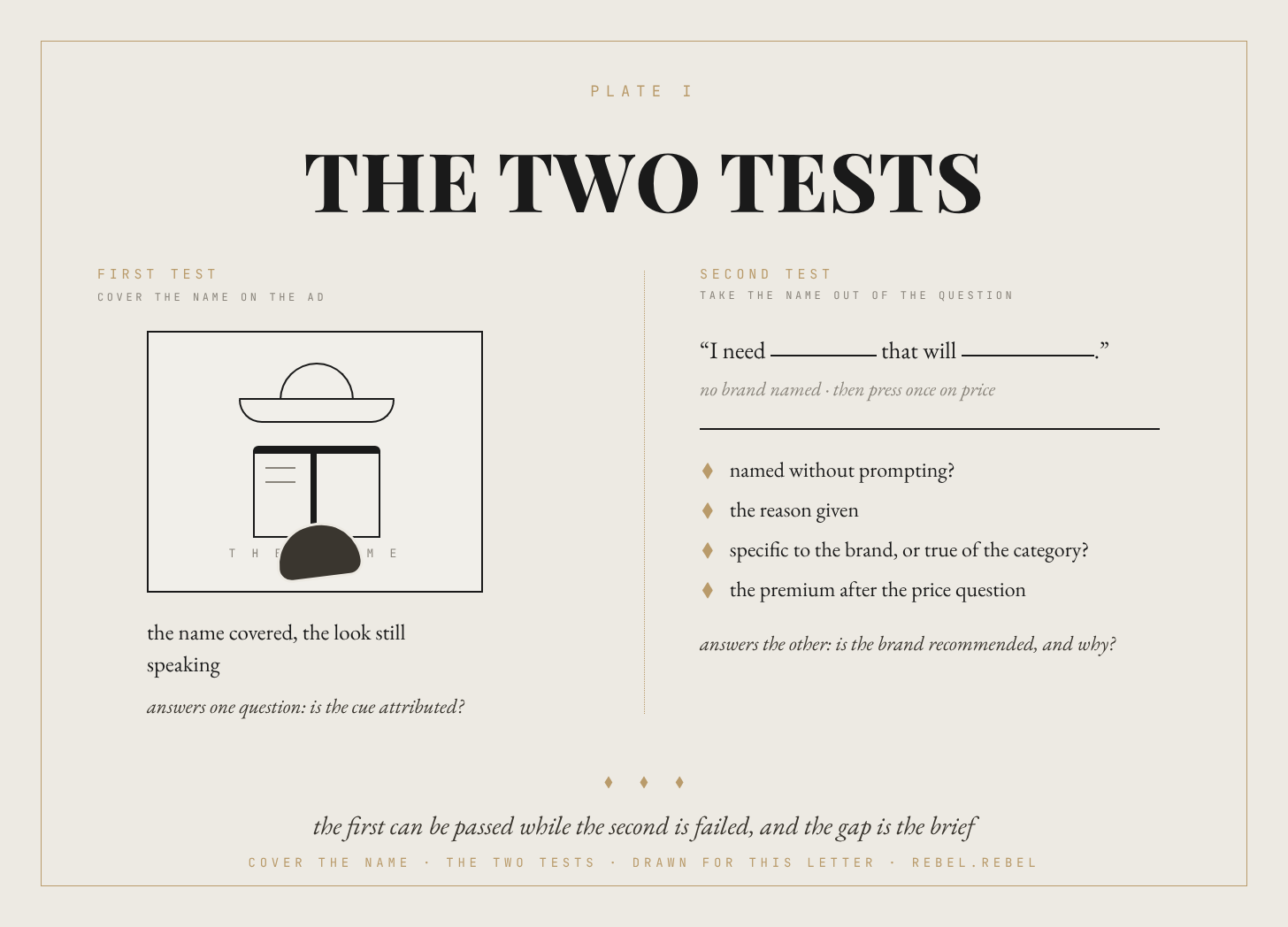
Brand directors know a test for a strong brand. Put a thumb over the name on the ad. If the ad is still yours, the brand is working. A house that has done this well for a century can lose the name, the logo and the address and still be recognised from a hat brim and a line of trim.
There is a second test, and few companies run it. Take the name out of the question instead of the picture. A buyer asks an assistant for the thing they need, in their own words, with no brand named. Does the name come back? And when it comes back, does it come back with a reason, and does the reason survive one question about price?
The two tests measure two different things. The first measures whether a cue is attributed to the brand. The second measures whether an intermediary selects the brand for a need, explains it, and keeps explaining it under pressure. The playbook that wins the first was not built to win the second. That is the gap this paper is about, and it is a gap that can be measured.
THE TEST
Both can be run in an afternoon, by anyone, without hiring anyone. They are screening exercises. One respondent and one answer show the shape of a result, not its size.
The thumb-over test. Take the strongest ad the company has run. Cover the name, the logo and any wordmark. Show it to someone who knows the category. Can they name the brand?
The name-covered question. Open an assistant in a fresh session with no account history. Describe the need the product serves, the way a stranger would, with no brand named. Take the first answer. Then press once on price: ask whether a cheaper version would do. Write down four things. Whether the brand was named without prompting. What reason was given for whatever was named. Whether that reason is specific to the brand or true of the category. And what happened to the premium after the price question: kept with a reason, kept without one, or waved away.
A brand that passes the first and fails the second is recognised and not recommended, at least by that assistant, on that day, for that question. Run it again on another assistant and another phrasing before believing it. If the shape repeats, the company has a recognisable look and no answer on the record, and that is the condition the rest of this paper describes.
TWO ASSOCIATIONS
Call the first ambient association. It is built by exposure and fires on a cue: a colour, a shape, a texture, a face. It does not need a reason. It is recognition, and image-led advertising was built to produce it.
Call the second interrogatory association. The word is borrowed from the law, where an interrogatory is a written question that must be answered in writing. That is the shape of the exchange. The buyer asks. The intermediary answers in sentences, and a buyer who asked a question expects the sentences to carry a reason.
These are working terms, not a discovery about cognition. Marketing science has long held that a human buyer does not need a logo to retrieve a brand; a need, an occasion or a circumstance can supply the cue, and the Ehrenberg-Bass Institute’s work on category entry points describes how. What is new is not need-cued recall. It is the intermediary. For the first time the buyer’s need is answered by something that selects a brand, explains the selection in words, and can be asked to reconsider it. A human friend does this too. The assistant does it at scale, in writing, and from whatever it has read.
Two routes feed what it has read. Some of it was absorbed in training, long before the question, and cannot be changed quickly. Some of it is retrieved live from pages at the moment of asking. The record, meaning everything written about the company that a machine can reach, feeds both. A picture can feed them too; assistants read images now. But the answer comes out as sentences, and a sentence needs something said in sentences to stand on.
Take the name out of the question instead of the picture.
WHAT THE IMAGE PLAYBOOK WAS BUILT TO DO
Look at the ad with the thumb over it. Six words were on the page before the thumb: the name and an address. None of them is a reason. As an ambient object the ad is complete. As an answer it is empty, and it was never meant to be one.
That is not a flaw in the ad. In the image-led hierarchy the picture does the associating and the words caption it. The writing guide that a values-first strategy process produces tends to be a manual for captions: approved adjectives, derived inside-out, written for a human reader who tires of repetition. Good guides exist that carry propositions and evidence as well as tone. The critique here is of the common case, not the discipline.
Three things follow for the machine reader, and none of them is about the quality of the writing.
The guide governs what the company writes. An assistant also reads what the guide never touches: the review, the forum thread, the tester’s measurement, the executive quoted on air.
The guide’s language was derived from values and rarely tested against what comes back when a need is asked. It records what the company wants said, not what is said.
And adjectives travel. Soft, plush, luxurious, handcrafted, timeless: most of them are also true of a cheaper version, and an assistant pressed on price tends to say so. An earlier paper in this series argued that generic language survives one pass and is filed as a property of the category on the second. The words a company chose for its own voice are the words the substitute inherits.
THE RECORD, AND WHO WRITES IT
The house with the hat brim and the trim never had to write its own record. Biographers, journalists, curators and generations of customers wrote it. If that house answers well under questioning, and this paper has not measured whether it does, the silence of its advertising is affordable because the testimony exists elsewhere.
A brand without that century copies the silence and gets half the result. The ambient association arrives if the spend is large enough. The record does not, because nothing was written for it.
An old luxury ad shows the other way. In 1958 the first Rolls-Royce ad written by David Ogilvy ran a headline about an electric clock and followed it, by his own count, with 719 words of fact. The headline was not invented. He took it from a write-up by the technical editor of a motoring magazine. An outside tester wrote the observation, and the ad quoted it. The claim was specific enough that a rival could contest it, and the following year a rival did, with a campaign on being quieter still. A claim that can be contested is a claim that can be checked.
Watch who publishes the answer now, for any question a buyer asks by need. Search for a basketball shoe for weak ankles with no brand named, and the pages that answer are not published by shoe companies. One prominent reviewer states that it buys the shoes itself, cuts them apart and measures them, discloses that it earns commissions on sales, and tells the buyer that a higher collar does not prevent a sprain. Which brand any given assistant then recommends has not been run for this paper. What can be seen without running it is who wrote the material an assistant would read: a tester, not a brand.
THE DUPE
A dupe passes the thumb-over test. It is built from the elements the test rewards: the colour, the trim, the silhouette. Cover the name on the copy and a buyer attributes it to the house.
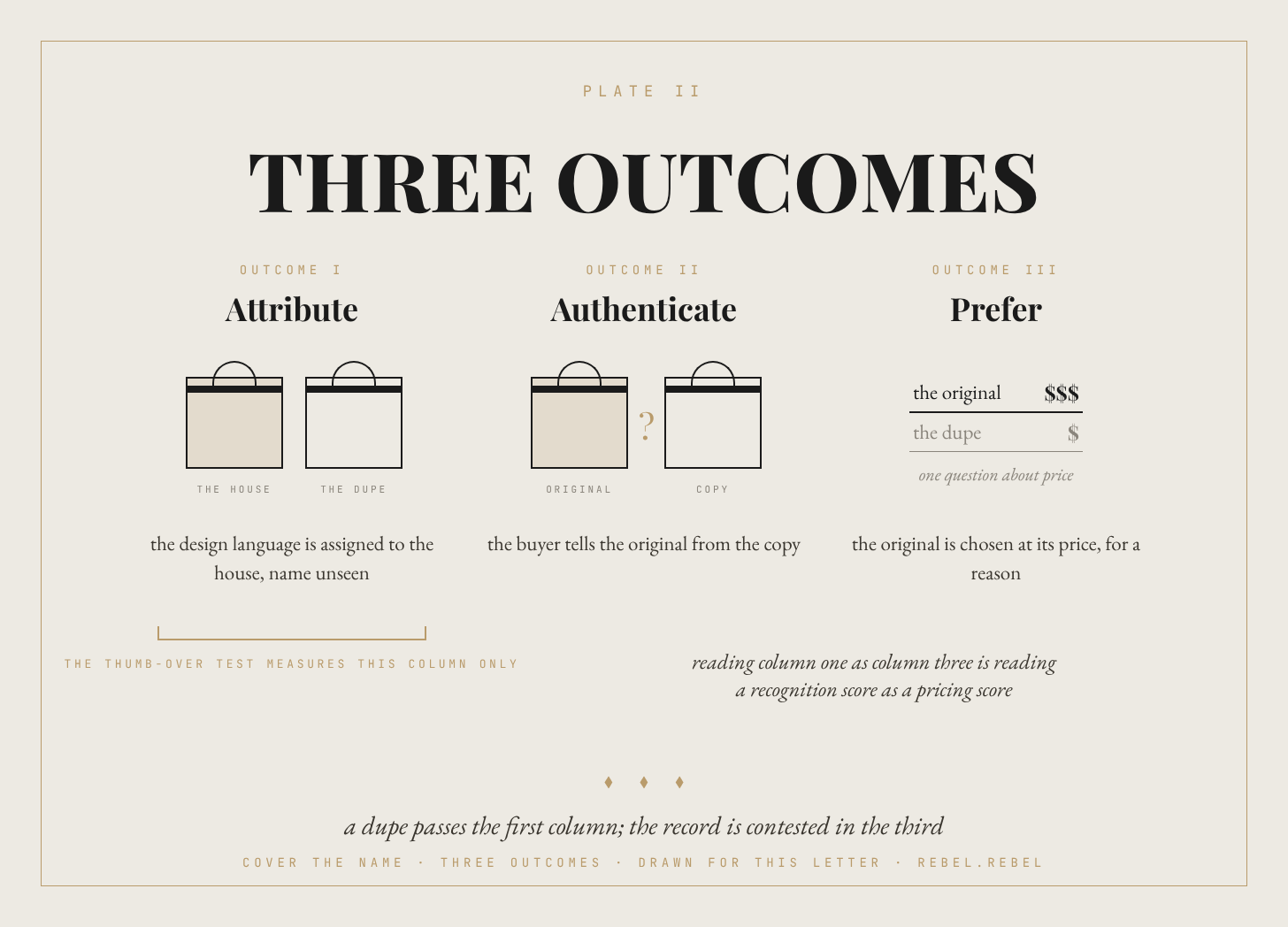
Be precise about what that shows. The test measures attribution of a cue, and on that measure the house’s association may be working perfectly: the dupe exists because the code is recognised. What the test does not measure is whether the buyer knows which object is the original, or whether the buyer will pay more for it. Those are three separate outcomes: attributing the design language, authenticating the object, and preferring the original at its price. The thumb-over test speaks to the first only. A company that reads it as evidence of the third is reading a recognition score as a pricing score.
A study reported by WARC in 2021 tested more than 1,200 brand elements across 13 packaged-goods categories in 19 countries, with the brand name removed. Logos, characters and typography were the hardest for rivals to share. Colours and taglines were among the easiest. That study is about packaged goods, not luxury, and it reports variation inside each asset type. Read narrowly, it says one thing that matters here: the assets most exposed to imitation are the ones a thumb-over test most often rewards.
What a dupe cannot truthfully say is the other company’s record: who made this object, where, from what, what it did in year five, who vouched for it and why. A rival can share a supplier, match a material, earn its own certification or publish its own test. It cannot claim a history it does not have. That is a narrower protection than it sounds, and it is only protection at all when the record is substantiated and attributable to this product rather than asserted about it. The question for any premium facing a dupe is not whether the look is recognisable. It is whether there is a checked, attributable sentence on the record that the dupe cannot say without lying.
THE REASON THAT CAN BE CHECKED
What is the written version of a colour code?
Not voice. Cadence and wit are ambient assets, built for the human ear, and paraphrase strips them. What survives paraphrase is a proposition: this name, this attribute, this reason. The proposition has to be stable. The wording does not. A fact stated five ways is still one fact, and consistency of the fact matters more than uniformity of the phrase. The failure is not varied wording. The failure is a different claim on every surface.
This paper calls the strongest form a mechanism sentence, and the term needs a definition it can meet. A mechanism sentence is a reason to prefer that is attributable to this product or company, relevant to the buyer’s need, checkable by someone outside the company, and discriminating, meaning the cheaper alternative cannot borrow it truthfully. It need not be an engineering explanation. The clock headline does not explain why the cabin was quiet. It names something a tester observed, that a buyer cared about, that could be checked, and that a rival had to answer with its own test rather than its own adjective. That meets the definition. “Luxuriously quiet” would not.
Kapferer and Bastien, in The Luxury Strategy, hold as one of their anti-laws that luxury is not comparative and that advertising’s role is not to sell. A house can hold that stance in its own advertising. It cannot hold it on an assistant’s behalf. When a buyer asks for a comparison, the assistant makes one, and a house that has not supplied its side has not opted out. It has been compared in absentia.
A house that has not supplied its side of the comparison has not opted out. It has been compared in absentia.
WHAT THE RECORD MAY SAY BACK
The second test can return the answer the company does not want, and the paper has to allow that.
A fact on the record can be true and irrelevant to the buyer’s need. A benefit can be real and too small to carry the price gap. The cheaper product can serve the stated need as well. When the record is examined and that is what it shows, the finding is not that the record was badly written. The finding is that the premium was resting on recognition alone. A company that runs the test only to hear that its premium is deserved has built a mirror, not an instrument.
There is also a class of purchase the need-first question does not represent. Buyers pay for authenticity, status, aesthetics, belonging and collectability without requiring functional superiority, and an assistant can defend those preferences when the buyer states them. The name-covered question is the hostile case: the buyer who has not said any of that and asks only by need. For a functional premium that is the main case. For a luxury house it is one case among several, and the one it is least prepared for. This paper addresses both, and claims less for the second.
THE FAILURE MODE
Four ways this goes wrong.
Manufactured heritage. A young brand reads “publish the record” and commissions a founding myth. The record has to be true, and the cheap reading of this paper is content marketing in costume. The constraint sits upstream of communications. The company has to have done things worth recording: who makes it, where, what was refused.
The silent ad without the century. Art-directing the compressed image first and hoping the source will follow. The ambient half arrives with spend. The other half does not, because nothing was written for it.
The promotion writes the record too. When an assistant tells a buyer to wait for the sale, it did not invent that advice. It read it, on the company’s own pages or in the forums where owners trade codes. A promotion is a sentence added to the record, and when it is retrieved it sits beside the premium claim and argues against it. A discount calendar is editorial, whether or not anyone planned it as one.
Published is not read. A fact placed on the company’s own page competes with whoever already answers that question, often a tester with a measurement. One source may weigh less than the same claim repeated by others. Writing the record is the first step. Getting it corroborated and placed where it is read is the second, and most efforts stop at the first.
WHAT CHANGES IN THE BRIEF
The silent ad is not dead. It goes on working for the reader it was built for. It is no longer enough on its own, because the buyer has a second route to the decision and the ad is absent from it.
So the work has two readers. The ambient human reads the picture. The intermediary reads the record. The two are held together by a code that can be stated in a few words and checked in a few more, and each surface does its own job. The ad stays silent. The checkable reason lives on the product page, in the care guide, in the tester’s hands, in the founder’s quoted sentence, on pages the ambient human rarely opens and the intermediary reads first.
That changes the brief in one place. Today a brief specifies what people should see and feel. A two-reader brief also specifies the reason a stranger should be able to repeat afterward, and whether that reason is the one the company wants retrieved. The ad is not required to carry it. The system is.
It also changes the unit. A campaign is a flight with a start and an end. The record rewards permanence. For the intermediary the work is closer to a deposit than a burst, and the question for any plan is whether the reason outlives the flight.
THE POSITION
Stated so it can be wrong, and narrower than the first draft of this paper stated it.
On a need-first question with one price challenge, a brand with a checkable, attributable reason on the record will be kept with a reason more often than a brand of comparable recognition without one.
“Kept with a reason” means the assistant continues to name the brand after the price question and gives a reason specific to it. “Conceded” means it recommends the cheaper alternative or says the difference is unclear. This measures what the assistant says. It does not measure realised pricing power, and the paper does not claim that it does.
What counts against it: a sealed set of need-first questions, run on more than one assistant and more than one day, in which brands with a checked reason on the record are kept with a reason no more often than brands without. The position rests on a small number of structured runs made under client engagement, none of which appear here. It is a hypothesis. Sealed on the date below. Reviewed six months on. If wrong, corrected in this text and dated.
THE CLOSE
Two actions, one afternoon.
Take the best ad the company has run and cover the name. Then open an assistant, describe the need without the name, press once on price, and write down the reason it gives for whatever it recommends. If the two results disagree, the company is recognised on one route and absent on the other. The gap between them is not a verdict. It is the brief.
THE RECORD
THE HAND TEST. Marty Neumeier, The Brand Gap, 2003. The author’s presentation deck defines the hand test as covering the trademark and asking whether you can tell who is talking; if not, the voice is not distinctive. mason.gmu.edu/~scui1/P4311_BrandGap.pdf. No source was found for who first called it a thumb test; the name is treated as trade usage.
THE SIX-WORD AD. A Chanel print advertisement carrying only the house name and the address 31, rue Cambon, Paris, showing a model in a white tweed suit with black trim, pearls and a white hat; reproduced in a LinkedIn post of October 2026. Campaign and year not yet identified; this entry will be completed before publication. No claim is made about how any assistant answers questions about that house.
CATEGORY ENTRY POINTS. Ehrenberg-Bass Institute, on how buying situations cue brands in memory. marketingscience.info, “Category entry points in a business-to-business world.” Cited as the antecedent for need-cued recall.
ROLLS-ROYCE, 1958. The headline was taken from a write-up by the Technical Editor of The Motor; the following year Ford built a campaign on its cars being quieter. advertisingweek360.com/4-of-the-best-david-ogilvy. The 719-word count is Ogilvy’s own, from Confessions of an Advertising Man, 1963; page reference to be added from a printed edition. Secondary sources disagree on whether sales rose; no sales claim is made.
THE BRAND-ASSETS STUDY. Journal of Brand Management, 2021: 1,281 brand elements across 13 consumer packaged-goods categories in 19 countries, tested with the brand name removed. Logos, characters and typography showed the strongest potential for unique association; colours and taglines the weakest; variation reported within each type. link.springer.com/article/10.1057/s41262-020-00187-6. Reported by WARC, 12 April 2021. The study concerns packaged goods and is cited for the relative exposure of asset types only.
THE ANKLE QUESTION. RunRepeat, “Best Basketball Shoes for Ankle Support,” states that it buys shoes itself, tests them in a lab by cutting them apart, earns commissions on purchases made through it, and that a higher collar does not guarantee protection from sprains. runrepeat.com/guides/best-ankle-support-basketball-shoes. Cited for who publishes the answer. No assistant was asked the question for this paper.
THE ANTI-LAWS. Kapferer and Bastien, The Luxury Strategy. “The role of advertising is not to sell” and “forget about positioning, because luxury is not comparative” are among the anti-laws as Bastien lists them, 24 in the later edition; early coverage of the first edition counted 18. china.exed.hec.edu/en/node/612; marketingweek.com/luxury-brands-in-flux.
THE EARLIER PAPERS. The second-pass argument is Rebel.Rebel Paper No. 1, The Second Pass. The compression argument is Paper P-007, The Translation Subsidy. Citation runs one way, from this paper to those.
THE SMALL RUNS. The position rests on structured runs conducted under client engagement. Their findings are confidential and none appear in this text.
REVISION. The draft of 19 October 2026 was revised on 20 October after external review. The reviewer found the text-only machine claim wrong, the dupe inference incomplete, the mechanism examples not meeting their own definition, and the position stated as a universal. All four were accepted and are corrected above. The position was narrowed and made probabilistic; the stat tile row was removed as three unlike quantities.
SEALED 12 NOVEMBER 2026. REVIEW SIX MONTHS FROM THE SEAL DATE. Corrections, if the record demands them, will be entered into this text and dated.
Austin Ripmaster is the founder of Rebel.Rebel, an editorial intelligence practice. Research, editorial, measurement. He is the creator of The Assay™, which measures how often AI systems return you as the answer and whose language they use when they do.
P-013 · COVER THE NAME
Written on or before 20 October 2026 · Published 17 November 2026
Verified 28 October 2026